
Immerse yourself in the local community then relax on the beach and see local culture and Farankaraina wildlife
Our Cultural Experience allows visitors to gain a more intimate perspective of the local community, by interacting directly with the people. There are many people who want to learn English, and students welcome the opportunity to practise with native English speakers. In this package, you will spend a few days in Maroantsetra doing different activities while accompanied by young students eager to put their Englishs skills into practise.
The following 3 days are spent at the Aye-Aye Forest Camp where you will able to experience different local culture during a visit to a local village. Of course, the main activity will be looking for wildlife in the Farankaraina forest, directly behind the ecolodge, or during a day-trip to Nosy Mangabe.
The following itinerary is only a suggestion, and activities may vary.
Day 1: Orient yourself in Maroantsetra

Your guide will meet you at the airport and transfer you to a modern, air-conditioned hotel in Maroantsetra, overlooking the river.
Once you have settled, your guide, a local English teacher, will introduce you to some of his students, and they will take you on an introductory walking tour of Maroantsetra.
Visit WCS' (Wildlife Conservation Society) Open Learning Classroom, a centre for students to learn English and environmental topics. Visit the Fandroakando NGO office and speak with the staff who work with the communities to protect the Farankaraina forest. Walk through the busy market, the main shopping area for everything from fresh produce, to clothing and household items.
Day 2: City nature and kids

Today a new group of students will accompany you and your guide on your visit to a local fish farm, the local crocodiles, and an area that has been preserved to help maintain the native population of tomato frogs.
In the afternoon, join a group of young kids and play games to help reinforce their spoken English.
Day 3: Classroom teaching and games

In the morning, visit your guide / English teacher's private school, and participate in an English class.
In the afternoon, join the Aye-Aye Environment Club, a group of students who meet weekly to practise their English and discuss environmental topics. If you were prepared to speak on an environmental topic, the students would welcome your presentation. The guide can arrange to have a projector display a presentation from your computer.
After the club meeting, join the students in a game of ultimate frisbee, with jerseys and frisbees donated by a previous guest.
Day 4: Transfer to Aye-Aye Forest Camp, visit Farankaraina

Today you will transfer to the Aye-Aye Forest Camp.
During the 45 minute boat ride on the river, look out for the malachite kingfisher, red fody or grey heron. After a 15-minute walk, you will be greeted at the camp with a welcome drink, and orientation session. Unpack, enjoy a stroll or even a swim at the beach.

In the afternoon, head into the 3000ha Farankaraina forest. The Aye-Aye Forest Camp maintains a network of 10km of trails, each with their own characteristics. Look for white-fronted brown lemurs and one of the groups of red-ruffed lemurs.
As the sun sets, head out for a night walk, listening to the chorus of frogs and the scops owls calling each other. Look for dwarf and mouse lemurs, and of course the aye-aye.
Day 5: Birding, lemurs and Village visit
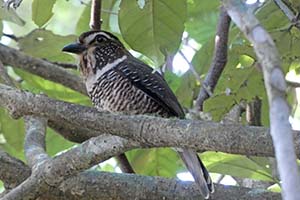

Birders may want to head out at sunrise to look for the short-legged ground roller, red-breasted coua or the Madagascar wood-rail and return for a late breakfast.
Or, after a hearty breakfast, put on your hiking shoes for a 2-3 hour hike to the summit - 270m in elevation. The summit trail takes you through changing landscape, where you might encounter any of Farankaraina's birds or lemurs. Near the summit, there is a rock with marble-sized indentations; legend has it that it was used as a game board in the time of the King Rabondro. A few more steps and you reach the summit with a spectacular view overlooking the whole of the Antongil Bay: the backdrop of the Farankaraina forest extends to the village of Navana, to Nosy Mangabe, and south to the Masoala peninsula where you may spot whales through your binoculars. Enjoy the peace and quiet, and cool off in the gentle breeze while looking for the Madagascar buzzard or other raptors sweeping the sky.
WARNING: the drop-off from the summmit is very steep and there is no guard rail. Guests should stay well away from the edge of the rock platform.

In the afternoon, travel in a pirogue (a local, wooden canoe) to visit the village of Ambodivohangy. A farmer will explain how they grow local crops (vanilla, cloves, peppers, papaya, breadfruit, jackfruit, cacao, rice,...) and then the Women's Association will perform the toka toka, and other traditional dances. Make sure you bring some Ariary to spend on locally made crafts.
In the evening, walk along the beach looking up at the southern hemisphere stars, but keep an eye on the ground as the many ghost crabs skitter along the beach.
Day 6: Nosy Mangabe and Nosy Fanihy, and night walk

Head out early to hear the cacophony and watch the activity of the flying foxes nesting in the trees at Nosy Fanihy. Then cross the short distance to Nosy Mangabe, the island jewel of Masoala National Park. The black and white ruffed lemurs are only found on this island in the Antongil Bay. Your guide may also spot a Brookesia peyrierasi, the second smallest chameleon species. Enjoy a picnic lunch packed from our camp, followed by exploring more trails, looking for a well-chamouflaged leaf-tailed gecko, or a pygmy kingfisher.

Head back to the camp mid-afternoon, enjoy a swim or a nap, and then enjoy another night walk where your flashlight might catch a nose-horned chameleon or the glow from the eyes of a woolly lemur, and have another chance at finding an aye-aye.
Day 7: Early birding or swim, transfer to Maroantsetra
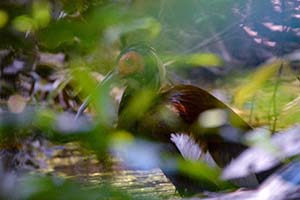
Early risers may take advantage of one last walk in the forest to spot blue coua, Malagasy white eye or a Madagascar ibis. Or enjoy one last swim in the ocean.
After breakfast, once again enjoy the quiet river transfer back to Maroantsetra and then spend your last afternoon in a modern hotel overlooking the bustling commerce in the streets and along the river.
Day 8: Transfer to airport

Flights to Antananarivo are generally in the late morning. Transfers will be arranged by the hotel.
There is an option to stay the last night at the Aye-Aye Forest Camp if you would like to take enjoy the forest and the beach, and benefit from one extra night walk on Day 7. In this case you would leave the Aye-Aye Forest Camp early in the morning, and be transferred directly to the airport.